
USDA: THE MAGAZINE THE FITZGERALD BLUEPRINT
LOS ANGELES — USDA CFB27 is officially underway.
And before Coach Konrad Fitzgerald has coached his first meaningful snap back at USC, the blueprint for what he wants the Trojans to become is already beginning to emerge.
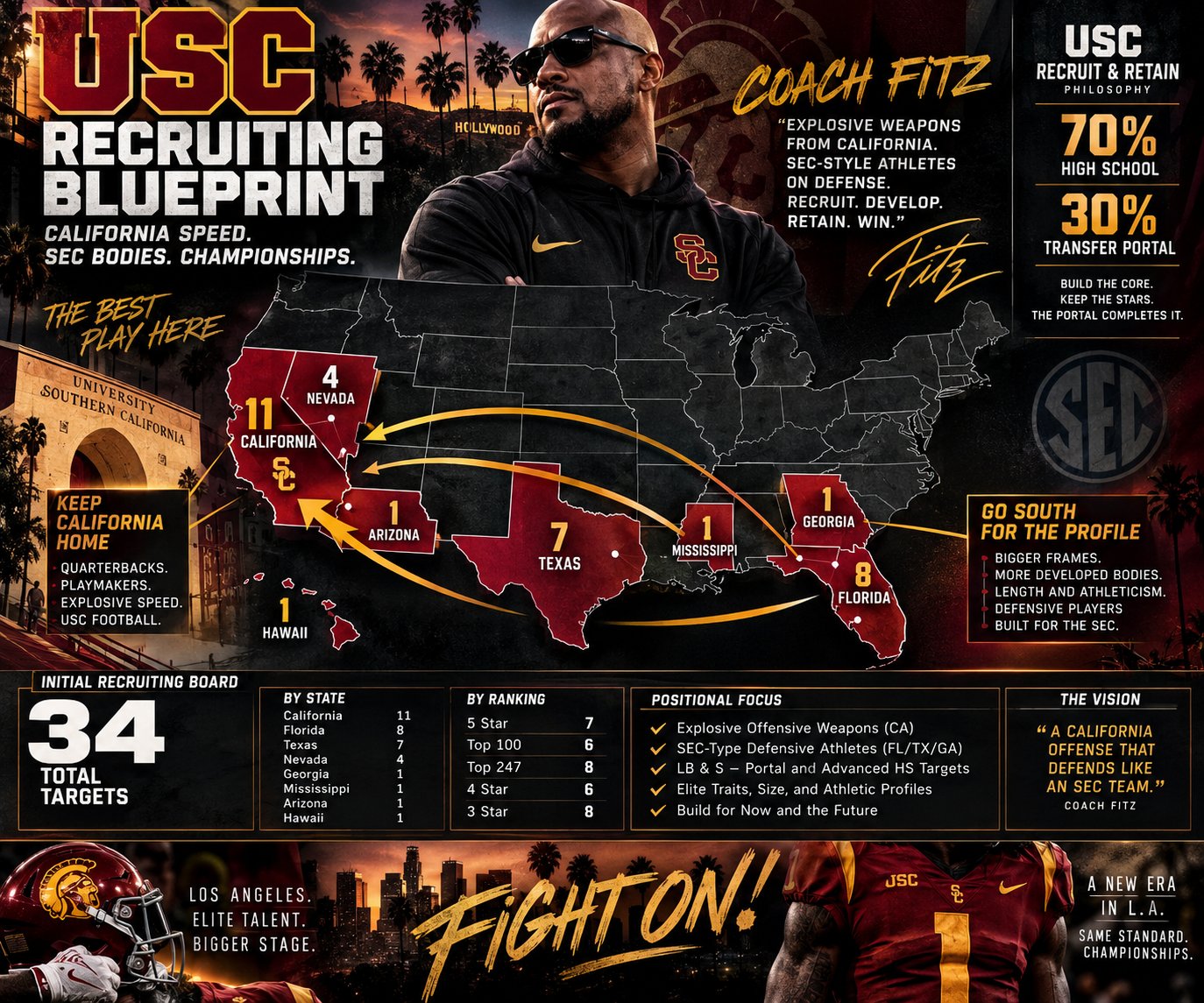
USC’s initial recruiting board features 34 prospects across eight states, including seven 5-stars and 21 players ranked inside the Top 247.
But this isn’t simply a collection of highly ranked recruits.
There’s a philosophy behind the geography.
There’s a philosophy behind the body types.
And there’s a philosophy behind where Fitzgerald intends to find them.
Build the core through high school. Keep California’s explosive talent home. Go South for more physically developed defensive athletes. Develop them. Retain them. Win with them.
USC has officially declared itself a 🏆 Recruit & Retain program.
And Fitzgerald already appears to know exactly what he wants that to look like.
⸻
🌴 KEEP CALIFORNIA HOME
The largest group on USC’s opening board comes from exactly where you’d expect:
California — 11 prospects.
For Fitzgerald, California isn’t merely USC’s recruiting territory. It’s supposed to be the source of the explosiveness that defines the Trojan offense.
Quarterbacks. Receivers. Running backs. Playmakers.
The West Coast has long produced the type of space athletes capable of making USC football look like USC football, and Fitzgerald’s strategy begins with keeping more of them home.
The goal is an offense built around speed, explosiveness and players who can change games with the ball in their hands.
And USC’s Western footprint doesn’t stop at the California border.
Nevada has four targets, while Arizona and Hawaii each contribute another.
That gives USC 17 initial targets from California, Nevada, Arizona and Hawaii.
Exactly half the board.
The West is the foundation.
But the other half tells us where Fitzgerald intends to find something different.
⸻
🐊 GO SOUTH FOR THE PROFILE
USC’s opening board includes:
Florida — 8
Texas — 7
Georgia — 1
Mississippi — 1
That’s another 17 prospects.
And Fitzgerald’s interest in the Southeast isn’t simply about recruiting rankings.
It’s about physical development.
USC wants to identify high-school defenders who already possess more of the physical profile Fitzgerald ultimately wants his defense to have — bigger frames, length, explosiveness and developed athletic bodies that potentially require less projection once they arrive on campus.
The vision is essentially to build an SEC-style athletic defense in Los Angeles.
That doesn’t mean simply recruiting bigger players.
It means finding the combination.
Defensive linemen with mass who can move.
Edges with length and acceleration.
Linebackers who can run without being undersized.
Safeties with legitimate frames and coverage athleticism.
Corners with length, speed and physicality.
Fitzgerald isn’t interested in choosing between size and athleticism.
He wants both.
And the Southeast and Texas will be major hunting grounds for finding it.
⸻
🧬 BODY TYPE OVER ZIP CODE
That’s an important distinction in understanding USC’s strategy.
This isn’t Fitzgerald declaring that California produces offensive players and the South produces defensive players.
USC will recruit elite players anywhere.
What we’re seeing instead is a trait-based approach to geography.
California naturally gives USC access to one of America’s premier collections of offensive skill talent.
Meanwhile, Fitzgerald is deliberately expanding USC’s defensive search into regions where he believes he can find more high-school players who already possess the size, length and athletic development he’s looking for.
If that player is in Southern California?
Keep him home.
If he’s in Miami?
Go get him.
If he’s in Dallas, Atlanta or Mississippi?
USC intends to be there.
The objective isn’t to recruit a map.
It’s to recruit a profile.
⸻
🏆 RECRUIT. DEVELOP. RETAIN.
USC’s choice of Recruit & Retain may ultimately tell us even more than the opening board itself.
Fitzgerald has committed USC to a philosophy that places 70% of its Talent Acquisition resources toward high-school recruiting and 30% toward the Transfer Portal.
And this isn’t a one-year experiment.
Under USDA rules, Fitzgerald is locked into that program-building identity for the next three seasons.
That means USC isn’t planning to live offseason-to-offseason hoping the portal fixes its roster.
The expectation is that the majority of future Trojan starters will be players USC recruited itself.
Sign them at 18.
Develop them.
Get them onto the field.
Retain them when they become stars.
Then use the portal strategically to finish the roster.
That’s the model.
⸻
🛡️ THE LB & SAFETY EXCEPTION
There is one particularly interesting wrinkle in Fitzgerald’s roster construction.
Linebacker and safety are two positions USC expects to attack aggressively through the Transfer Portal.
That’s intentional.
Fitzgerald’s defensive structure puts a premium on those positions. With two linebackers and three safeties regularly on the field, USC needs five second-level defenders who can handle significant responsibility.
And those are positions where Fitzgerald sees value in acquiring players who have already spent time developing at the college level.
But even here, the opening recruiting strategy matters.
The portal preference at LB and safety doesn’t mean USC will stop recruiting those positions from high school.
Instead, Fitzgerald can be more selective.
If USC finds a high-school linebacker in Florida with the size, movement skills and developed frame they’re looking for, that’s exactly the kind of player worth developing internally.
Same with a long, athletic safety from Texas or Georgia.
The Southeast strategy gives USC an opportunity to find younger versions of the same physical profiles Fitzgerald would otherwise be hunting in the portal.
If those evaluations hit?
Over time, USC may need the portal less.
That’s exactly what Recruit & Retain is supposed to accomplish.
⸻
⭐ USC IS AIMING HIGH
Fitzgerald isn’t easing into his first recruiting cycle.
The initial 34-player board includes:
⭐ 5-Star — 7
🔥 Top 100 — 6
📈 Top 247 — 8
4-Star — 6
3-Star — 8
Altogether, 21 of the 34 targets — nearly 62% — are Top-247 caliber or better.
That’s an aggressive opening board.
There are developmental prospects included, but USC clearly intends to compete at the top of the market immediately.
And under Recruit & Retain, those evaluations become especially important.
Every high-school player isn’t simply a recruiting win.
He’s potentially part of a three- or four-year investment.
⸻
🗺️ THE BOARD TELLS THE STORY
Perhaps nothing captures Fitzgerald’s vision better than the symmetry of USC’s initial recruiting map.
WEST — 17
California — 11
Nevada — 4
Arizona — 1
Hawaii — 1
SOUTH — 17
Florida — 8
Texas — 7
Georgia — 1
Mississippi — 1
17 and 17.
One half of the board is built around protecting USC’s natural recruiting territory.
The other half reaches directly into the regions producing many of the physical profiles Fitzgerald wants to add.
It’s almost a perfect representation of what USC is trying to create.
⸻
✌️ A CALIFORNIA OFFENSE THAT DEFENDS LIKE AN SEC TEAM
Fitzgerald already knows what championship football at USC looks like.
Now, returning to the program where he previously won two national championships, he’s trying to build his next version of it.
And this one has a very specific DNA.
California supplies the electricity.
The West supplies the foundation.
The Southeast supplies another level of size, length and defensive athleticism.
The portal selectively supplements LB, safety and immediate needs.
High-school recruiting builds the roster.
Retention keeps it together.
That’s why USC’s first recruiting board matters.
The Trojans aren’t simply chasing stars.
They’re attempting to build a roster where eventually you can look at a player before seeing his rating and think:
Yeah. That’s a Fitzgerald USC guy.
34 targets.
8 states.
7 five-stars.
21 Top-247-or-better prospects.
17 from the West.
17 from the South.
The first recruiting cycle of USDA CFB27 has begun.
And USC has already made its intentions clear:
KEEP THE SPEED HOME.
BRING THE SEC ATHLETES WEST.
RECRUIT THEM. DEVELOP THEM. RETAIN THEM.
FIGHT ON.