
USDA Season 1 Portal Power Index
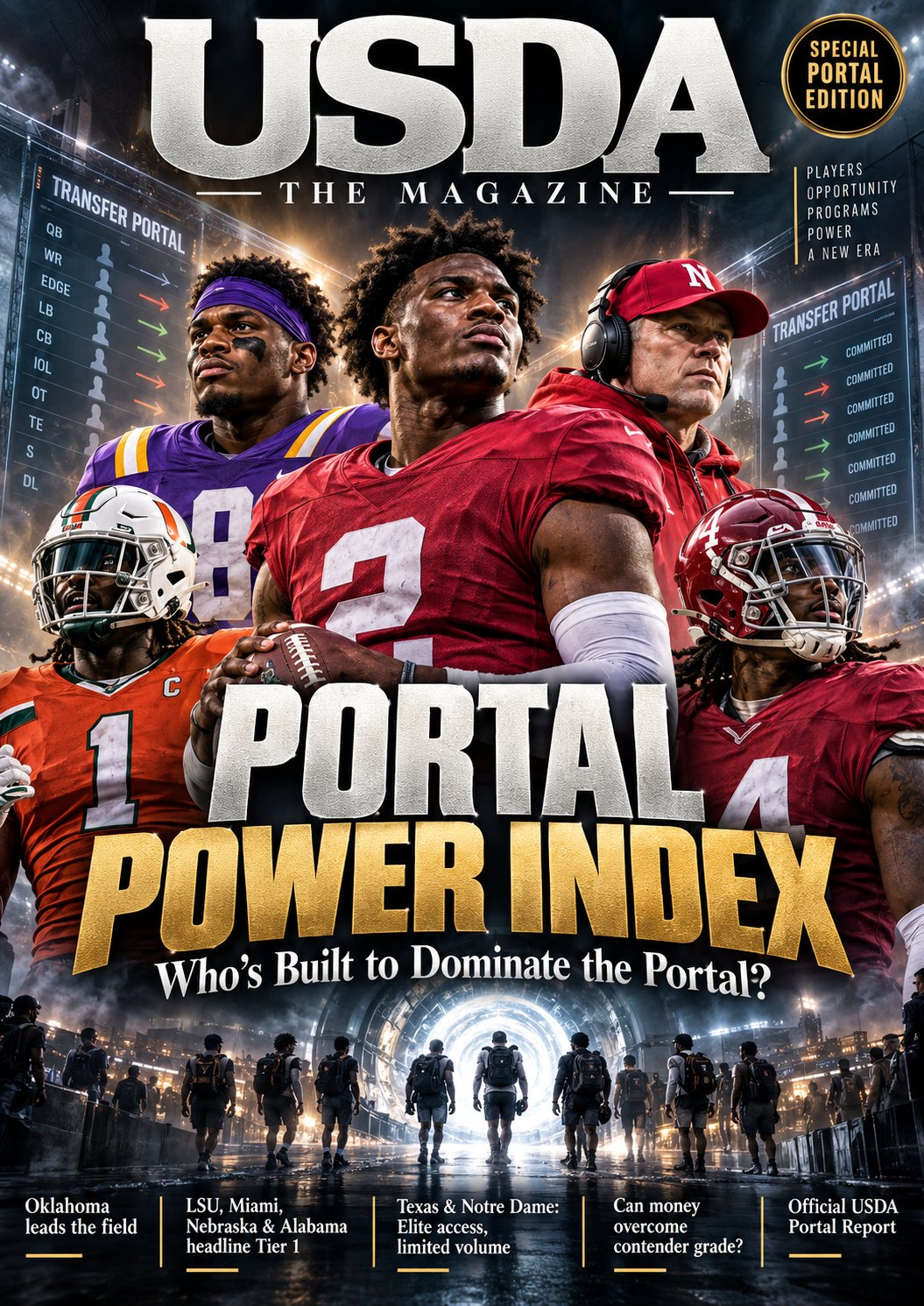
USDA PORTAL POWER INDEX — TEAM-BY-TEAM BREAKDOWN
Using the final model:
50% Championship Contender
30% Portal Budget
20% Brand Exposure
Championship Contender carries the most weight because it most directly affects the caliber of portal player a school can realistically access.
1. Oklahoma — 96.5
Budget: 2,310 | Champ: A | Brand: A
The strongest overall portal setup in USDA. Oklahoma combines the largest budget in the league with elite contender status and an elite brand. There are very few portal battles they should be unable to enter, and even fewer where they are financially outgunned.
Portal identity: Complete powerhouse.
2. LSU — 93.6
Budget: 1,895 | Champ: A+ | Brand: A
LSU has one of the best elite-player profiles in the league. The A+ contender grade gives them top-end access, while nearly 1,900 in portal money gives them enough flexibility to chase multiple premium targets.
Portal identity: Elite talent hunter with real volume.
3. Miami — 91.3
Budget: 1,640 | Champ: A+ | Brand: A+
Miami has the best pure recruiting pitch in USDA. The budget is not quite Oklahoma or Nebraska level, but A+/A+ means Miami should be extremely hard to beat when competing for players they prioritize.
Portal identity: Premium destination.
4. Nebraska — 91.0
Budget: 2,230 | Champ: A- | Brand: B+
Nebraska’s greatest advantage is sheer financial force. The contender and brand grades are good enough, and the 2,230 budget creates the ability to stay involved in more high-level recruitments than almost anyone.
Portal identity: Volume monster.
5. Alabama — 90.9
Budget: 1,800 | Champ: A | Brand: A+
Alabama has essentially everything needed to dominate. Strong access, a premium national brand, and one of the largest budgets in the league make them dangerous in both individual battles and overall class construction.
Portal identity: Traditional heavyweight with no real weakness.
6. Indiana — 86.1
Budget: 1,700 | Champ: A- | Brand: A
Indiana is one of the most interesting profiles in the league. The budget is substantial, the contender grade is strong, and the brand is now a real asset. Indiana should be capable of building one of the deeper portal hauls in USDA.
Portal identity: Emerging national power.
7. Texas — 83.2
Budget: 1,020 | Champ: A+ | Brand: A+
Texas lacks the giant war chest of the top programs, but their access is elite. They can shop at the very top of the portal. The limitation is simply how many expensive players they can take.
Portal identity: Elite sniper.
8. Notre Dame — 82.9
Budget: 990 | Champ: A+ | Brand: A+
Almost the same profile as Texas. Notre Dame cannot afford to spread itself too thin, but it can compete for elite targets that many richer programs may not have access to.
Portal identity: Quality over quantity.
9. Michigan — 82.8
Budget: 1,565 | Champ: B+ | Brand: A+
Michigan has a very healthy budget and one of the strongest brands in the league. The B+ contender grade slightly limits its ceiling compared with the true elite-access programs, but this is still an excellent portal setup.
Portal identity: High-end buyer with strong brand leverage.
10. Ohio State — 82.2
Budget: 1,135 | Champ: A | Brand: A+
Ohio State is another program whose recruiting profile is stronger than its budget rank. The contender and brand grades are elite, so Ohio State should have access to premium talent. It just has to be disciplined with spending.
Portal identity: Selective national heavyweight.
11. Florida State — 81.4
Budget: 1,760 | Champ: B+ | Brand: B
FSU has one of the biggest budgets in USDA. Its grades are not as strong as the programs directly above it, but the money gives Florida State a lot of flexibility and the ability to win bidding battles.
Portal identity: Cash-rich contender.
12. Florida — 78.3
Budget: 870 | Champ: A+ | Brand: B+
Florida is the best example of access outweighing pure budget. The Gators do not have much money relative to the league, but A+ contender status means they can recruit elite players. They just have to choose those players carefully.
Portal identity: Dangerous but budget-restricted.
13. UCLA — 77.2
Budget: 1,055 | Champ: A | Brand: B
UCLA has strong contender access and enough money to make meaningful moves. The brand grade is not elite, but the A contender grade gives them a legitimate shot at premium portal talent.
Portal identity: High-access selective buyer.
14. USC — 76.3
Budget: 1,140 | Champ: B+ | Brand: A
USC is very balanced. Strong brand, solid contender grade, usable budget. USC may not dominate any one category, but there are very few areas where it is weak.
Portal identity: Balanced national player.
15. Georgia — 75.2
Budget: 1,635 | Champ: C+ | Brand: A
Georgia is a fascinating case. The budget and brand are excellent, but the C+ contender grade limits the caliber of player it can consistently access. Georgia can still be very powerful inside the portion of the market available to it.
Portal identity: Big wallet, restricted ceiling.
16. Oregon — 72.3
Budget: 1,100 | Champ: B | Brand: A-
Oregon has a good overall profile but lacks an overwhelming strength. The brand is strong, the contender grade is respectable, and the budget is workable.
Portal identity: Solid all-around buyer.
17. Ole Miss — 72.3
Budget: 1,290 | Champ: B- | Brand: A-
Ole Miss has more spending power than Oregon but slightly weaker contender access. The strong brand should still help Ole Miss win plenty of meaningful battles.
Portal identity: Competitive upper-middle buyer.
18. Arkansas — 65.8
Budget: 830 | Champ: B | Brand: B-
Arkansas has respectable contender status, which helps keep them relevant despite a limited budget. The challenge is that one or two expensive additions can consume a huge portion of their available resources.
Portal identity: Needs precision.
19. Virginia — 65.5
Budget: 1,270 | Champ: C+ | Brand: C+
Virginia has enough money to be active, but neither the contender grade nor brand gives them a major recruiting advantage. Their path is winning with targeted spending.
Portal identity: Resourceful middle-market program.
20. Penn State — 65.4
Budget: 1,415 | Champ: C- | Brand: B+
Penn State has real financial power and a respectable brand, but the C- contender grade creates a significant access limitation. They should be able to dominate plenty of middle-tier recruitments, even if some elite options are unavailable.
Portal identity: Strong buyer in a narrower market.
21. Texas A&M — 65.1
Budget: 1,435 | Champ: D+ | Brand: A
A&M has one of the most uneven profiles in the league. The budget is good and the brand is excellent, but D+ contender status is a major obstacle. A&M can spend aggressively on players it has access to, but the available talent pool is more restricted.
Portal identity: Strong resources, major access problem.
22. Auburn — 62.4
Budget: 1,340 | Champ: C- | Brand: B-
Auburn has enough money to be relevant, but its contender and brand grades both trail the stronger portal programs. Auburn likely has to pay a premium to win important battles.
Portal identity: Cash-supported underdog.
23. SMU — 58.3
Budget: 1,220 | Champ: D+ | Brand: B-
SMU has respectable spending power, but poor contender access reduces what that budget can accomplish. The strategy should be aggressive targeting of players within their realistic pool.
Portal identity: Money without elite access.
24. Stanford — 56.3
Budget: 945 | Champ: C- | Brand: C+
Stanford does not have a major advantage in any category. Success will require identifying undervalued players and avoiding bidding wars against stronger portal programs.
Portal identity: Efficiency program.
25. South Carolina — 56.2
Budget: 670 | Champ: C | Brand: B-
South Carolina’s biggest issue is the budget. The contender and brand grades are workable, but 670 creates very little margin for error.
Portal identity: Extremely selective buyer.
26. Clemson — 55.3
Budget: 755 | Champ: D+ | Brand: A-
Clemson still has brand value, but the D+ contender grade and low budget combine to create a difficult portal environment. The brand can help win some recruitments, but Clemson cannot afford many expensive mistakes.
Portal identity: Brand-driven value hunter.
27. Mississippi State — 53.6
Budget: 700 | Champ: C | Brand: C-
Mississippi State lacks both premium resources and premium recruiting leverage. It needs to build through fit, opportunity, and efficient NIL use.
Portal identity: Developmental portal approach.
28. Iowa — 50.0
Budget: 695 | Champ: D | Brand: B
The B brand is helpful, but Iowa is near the bottom in both budget and contender access. Their portal strategy has to be extremely focused.
Portal identity: Limited-market specialist.
29. Missouri — 48.2
Budget: 705 | Champ: D | Brand: C+
Missouri has the toughest overall portal profile in USDA. The budget is small, contender access is poor, and the brand does not provide enough leverage to overcome those weaknesses.
Portal identity: Value hunting is mandatory.
FINAL USDA PORTAL OUTLOOK
The league breaks into three very different portal models.
At the top, Oklahoma, LSU, Miami, Nebraska and Alabama have the resources and access to build complete portal classes.
Programs like Texas, Notre Dame, Florida and Ohio State have elite access but must be more selective with money.
And teams such as Georgia, Penn State, Texas A&M and Auburn have enough NIL to be dangerous, but their championship grades mean they cannot simply buy their way into every elite recruitment.
That is what makes the Portal Power Index useful: it measures more than who has the biggest wallet.
It measures who can get in the room, who can afford to stay in the room, and who has the recruiting power to close.