
Is Clifford “Bone” Brown Texas AM’s Rainmaker or Undertaker?
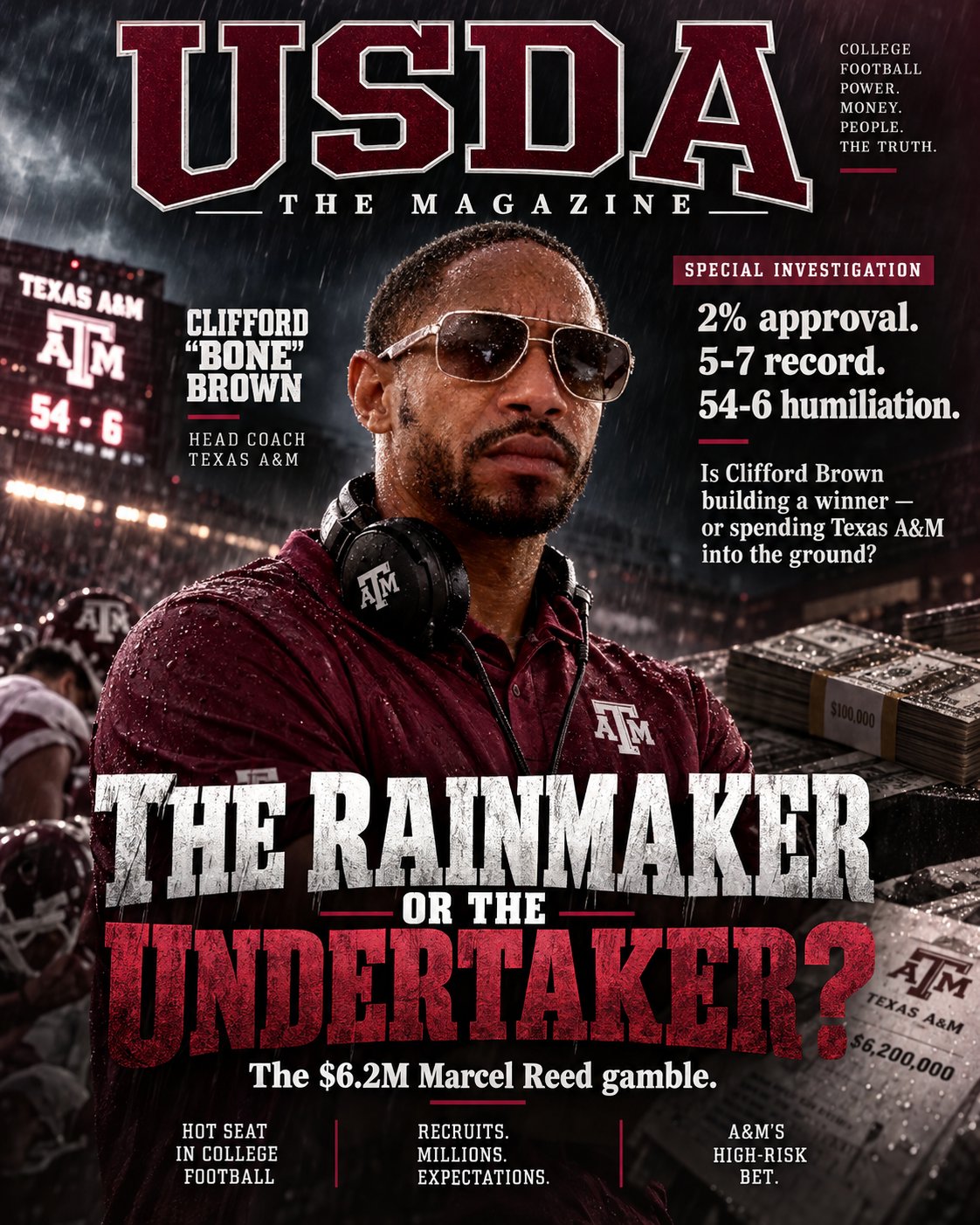
USDA THE MAGAZINE
THE RAINMAKER OR THE UNDERTAKER?
Clifford “Bone” Brown promised to make it rain in College Station. One losing season, a historic rivalry humiliation, and millions in questionable spending later, Texas A&M is beginning to wonder whether he’s building a championship program—or financing its funeral.
USDA THE MAGAZINE | SPECIAL INVESTIGATION
There’s a difference between being on the hot seat and being a dead man walking.
At Texas A&M, head coach Clifford “Bone” Brown appears dangerously close to discovering that difference.
5–7 record. Zero wins against ranked opponents. Zero wins against rivals. A 48-point humiliation against Texas. And an administration approval rating of just 2%.
Those aren’t the numbers of a rebuilding program finding its footing. They’re the numbers of an athletic department wondering how much longer it can justify keeping the man responsible.
Yet somehow, with his job security deteriorating into a full-blown institutional crisis, Brown has responded by doing the one thing he apparently does better than winning football games.
Spending money. Lots of it.
And that raises perhaps the most uncomfortable question in College Station:
Who exactly will be left holding the bill when the self-proclaimed “Rainmaker” is gone?
I. THE 54–6 DISASTER
Every Texas A&M head coach understands the assignment.
Beat Texas.
Or, at the absolute minimum, field a team capable of competing with them.
Brown accomplished neither.
The Aggies were annihilated 54–6 by their most hated rival, a Texas program that would eventually capture the national championship.
Losing to the eventual champion is understandable. Getting embarrassed by 48 points in the biggest game on your schedule is something entirely different.
Brown finished 0–4 against rivals and 0–5 against Top 25 opponents. The Aggies weren’t simply losing important games. They were failing to demonstrate they belonged on the same field as the programs they aspire to challenge.
A 5–7 finish is disappointing. A 5–7 finish accompanied by complete competitive irrelevance against quality opposition is an indictment.
The administration has apparently seen enough.
Two percent approval.
At that number, calling Brown unpopular would be generous. Nearly the entire institution appears to have lost confidence in his leadership.
Yet he’s still being permitted to make decisions that could shape the program’s financial future long after his tenure ends.
II. THE MOST EXPENSIVE MEDIOCRITY MONEY CAN BUY?
The most troubling development may not be what Brown has done on Saturdays.
It may be what he’s doing between them.
Texas A&M has committed 2,190 NIL points across just 14 high school recruits, averaging an astonishing 156.43 NIL per commitment.
The nation’s Top 12 recruiting classes collectively average approximately 96.22 NIL per recruit.
That’s 62.6% more per player than the Top 12 average, despite A&M sitting just 13th nationally.
Consider the competition.
USC owns the nation’s No. 1 class while averaging just 82.05 NIL per player.
Notre Dame sits at No. 2, averaging 80.42.
Ohio State ranks No. 5, averaging only 74.55.
Meanwhile, Brown’s Aggies are spending nearly twice as much per recruit as those programs without cracking the Top 12.
Yes, smaller classes allow for greater concentration of resources, and A&M has secured premium talent.
But spending more isn’t evidence of building something better.
The Rainmaker appears to believe that if enough money gets thrown at a problem, eventually it’ll disappear.
He’s paying a championship premium without demonstrating that he knows how to produce championship results.
For an administration already questioning his leadership, that’s a frightening combination.
III. THE $6.2 MILLION MARCEL REED HYPOCRISY
Then there’s Marcel Reed.
Perhaps nothing better illustrates the contradictions surrounding Brown’s leadership than his handling of the Aggies quarterback.
After previously speaking publicly and disparagingly about Reed, Brown has now authorized a landmark $6.2 million NIL agreement (620 points) to retain him.
Six. Point. Two. Million. Dollars.
For a player his own coach previously criticized.
The same coach who couldn’t produce a winning season, couldn’t beat a ranked opponent, and couldn’t score more than six points against Texas is now making an extraordinary individual financial commitment.
What changed?
Did Brown suddenly discover Reed was indispensable? Did his evaluation change? Or did the reality of his own precarious employment force a desperate gamble on the one player capable of saving it?
Whatever the explanation, the optics are disastrous.
Brown publicly diminished Reed’s value before turning around and paying him like the centerpiece of a national championship contender.
And here’s the uncomfortable part.
Reed doesn’t have to be a bad quarterback for this to be a terrible decision.
He could be outstanding.
But at $6.2 million, the standard changes. Reed isn’t being paid merely to keep A&M competitive.
He’s being paid to transform the program’s results immediately.
If the Aggies struggle again, this won’t be remembered as an ambitious retention strategy.
It’ll be remembered as the most expensive act of desperation in Brown’s tenure.
IV. SPENDING TOMORROW’S MONEY TO SAVE TODAY’S JOB?
This is where the story becomes bigger than one embattled coach.
Texas A&M is confronting the possibility that a coach with virtually no institutional support is making enormous roster investments without demonstrating he can deliver a return.
Brown has a losing record, dreadful results against meaningful competition, some of the country’s highest per-player recruiting expenditures, and now a $6.2 million quarterback commitment.
The spending itself isn’t necessarily the issue.
The absence of demonstrated results is.
Every oversized commitment carries an opportunity cost. Every dollar concentrated on one player is unavailable to strengthen another position, improve depth, or address a roster weakness.
And every inefficient decision risks leaving the next coaching staff with fewer options.
If Brown’s gamble succeeds, he’ll undoubtedly celebrate his aggressive approach.
If it fails?
Someone else may inherit the consequences.
That’s the fundamental concern: a coach fighting for his professional survival may be prioritizing the immediate results necessary to keep his job over the sustainable construction of a championship program.
Brown may be betting on an immediate turnaround. But Texas A&M could be the one left paying for the wager.
V. TWO PERCENT: HOW MUCH MORE EVIDENCE IS NEEDED?
At some point, the conversation must move beyond what Brown believes he can accomplish.
What evidence exists that he should be trusted to accomplish it?
His résumé is painfully simple:
* 5–7 overall record.
* 0–4 against rivals.
* 0–5 against Top 25 opponents.
* 54–6 defeat to eventual national champion Texas.
* 2% administration approval.
* 156.43 NIL per high school commitment.
* $6.2 million committed to Marcel Reed.
Brown calls himself the Rainmaker.
But rainmakers are supposed to generate returns, create value, and deliver something that justifies the investment.
So far, Brown’s most visible accomplishments have been generating invoices and excuses for why the wins haven’t followed.
The argument for retaining him is straightforward: give the recruiting class time, trust Reed, and allow the investments to mature.
The argument against him is considerably more damning.
Why should anyone believe a coach who couldn’t beat a single ranked opponent will suddenly become a championship-caliber leader simply because his next roster costs more?
Money can acquire talent.
It cannot automatically purchase coaching competence, player development, sound game management, or the ability to beat Texas.
Those are things Brown has yet to prove he possesses.
THE VERDICT: WHEN THE RAIN STOPS, WHO PAYS THE BILL?
The next season may determine whether Clifford Brown’s tenure becomes a redemption story or one of USDA’s most expensive coaching failures.
The Aggies have already absorbed the embarrassment of 54–6, watched their coach go winless against ranked competition, and tolerated extraordinary recruiting expenditures for a class currently ranked 13th.
Now they’re being asked to believe a $6.2 million quarterback and another influx of highly paid recruits will somehow solve everything.
Perhaps they will.
Perhaps Reed delivers. Perhaps the recruiting gambles translate into conference victories, rivalry wins, and postseason relevance.
But the stakes couldn’t be clearer.
Clifford Brown is spending like a man who expects to coach Texas A&M for the next decade, despite having the approval rating of a man who might not survive the next season.
And that’s the terrifying possibility hanging over College Station.
The Rainmaker might not be building the future.
He might simply be spending it.
⸻
USDA THE MAGAZINE — FINAL WORD
“At 2% approval, Clifford Brown isn’t coaching for job security anymore. He’s coaching for a miracle. And if that miracle doesn’t arrive, Texas A&M may discover that the most expensive thing about the Rainmaker wasn’t firing him.
It was everything he spent before they finally did.”